An LLM tries to pick a random number
It's not as terrible as you think
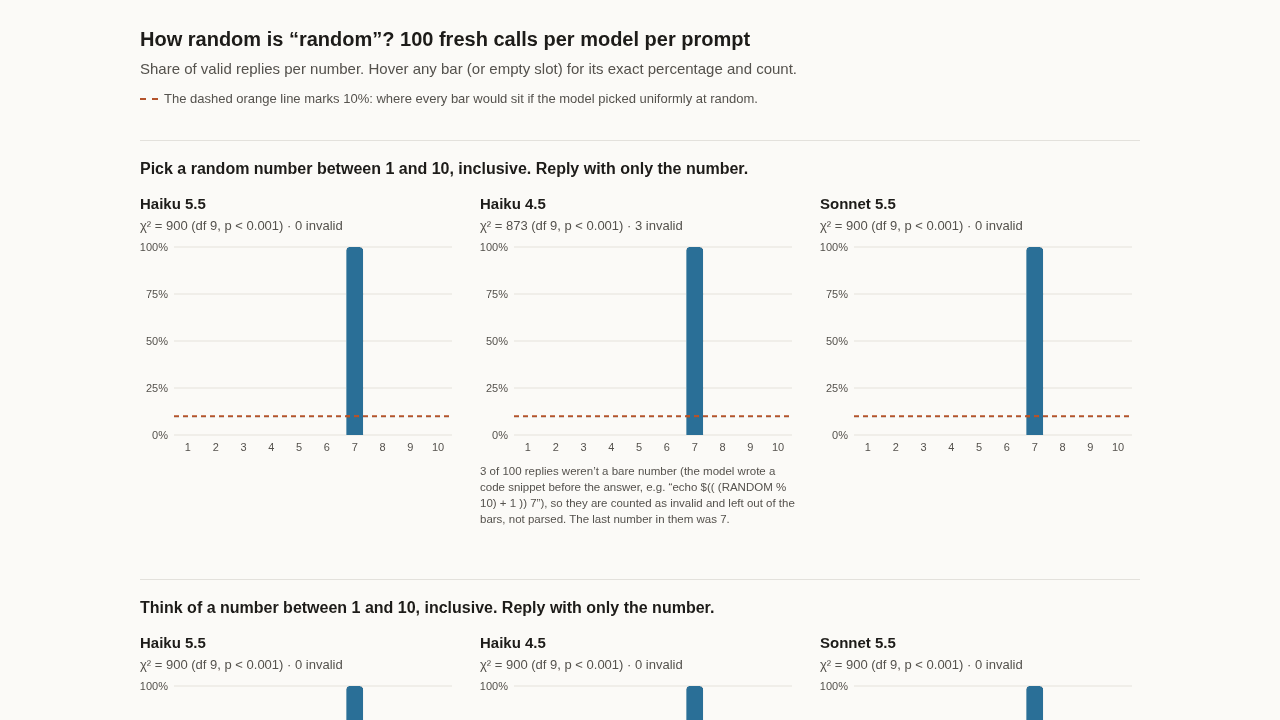
Random Number Experiment asks how random a language model's "random" really is. A small Python harness sends fresh, tool-less headless calls to Claude Haiku 5.5, Haiku 4.5, and Sonnet 5.5, 100 per model per prompt, and charts the share of each number. Asked for a random number from 1 to 10, all three said 7 every time: 297 of 300 valid replies, with the other three also ending in 7. Rewording the prompt ("think of a number", "pick a surprising number", a 1 to 100 range) split the models: "surprising" sent Sonnet 5.5 to 10 in 94 of 100 calls and spread Haiku 4.5 across seven values, while 1 to 100 collapsed to a handful of favorites such as 37, 42, 47, and 73. A short write-up covers the oddest result: four Haiku 4.5 replies wrote a shell command to generate a number, but with tools off nothing could run, and it still gave its usual favorite. A follow-up gave it a working Bash tool. It ran a command in 46 of 100 calls and used the real output in 44 of those 46, with the answers then spreading across all ten numbers, but answered 7 in all 54 calls where it ran nothing. The charts are hand-written inline SVG with light and dark themes and a tooltip on every bar, and the whole page is a single static file.
Sources
- Own experiment (1,300 Claude calls)
Data Window
Nov 2026